Data Analysis with Claude Code and more...
Claude Code is not just for programmers, we see how we can use Claude Code to produce a comprehensive analysis of a data set. Also, how to use Claude Code for free (maybe).
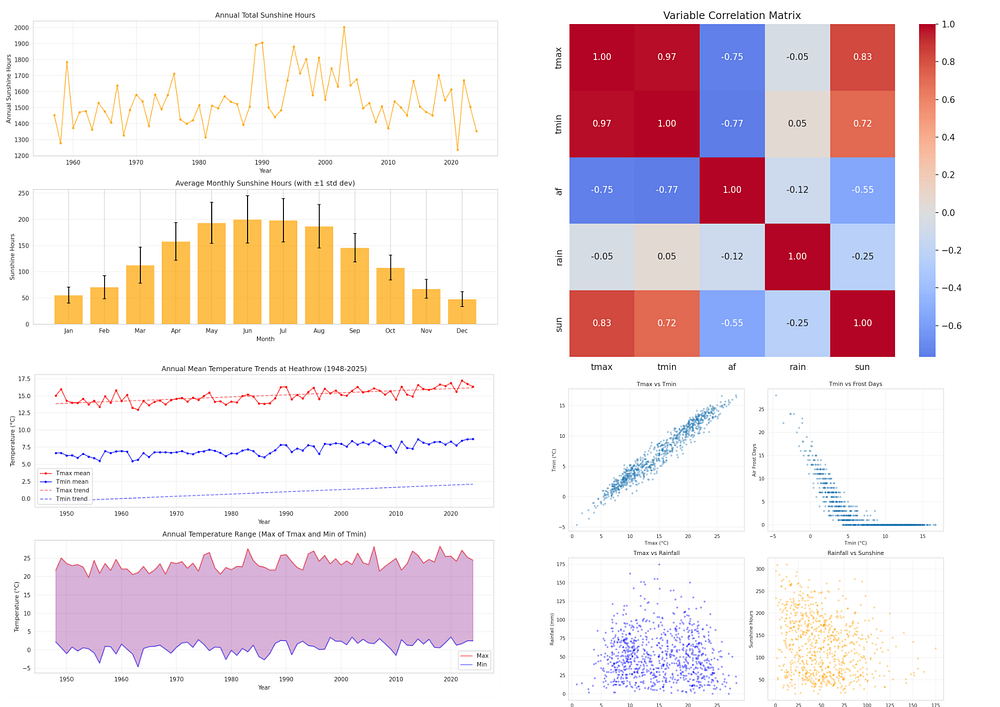
I analysed 78 years of London weather data and produced a comprehensive report with charts, without writing a single line of code. I did this with Claude Code for free.
So, today, there are links to two articles that you can read on Medium for free that cover the two topics.
Data Analysis with Claude Code — it’s not just for programmers
Claude Code has a good reputation as a programmer’s tool. It can also do a fine job of data analysis.
I used it to analyse decades of London weather records, got a comprehensive report with detailed charts (like those above) and found real evidence of climate change in London. Claude wrote and executed the code needed to load the data and create the charts, but it all ran in the background — I didn’t have to look at the code at all.
All I had to do was to describe my data, explain what I wanted to know, and Claude Code did the rest — the analysis, the statistics, the charts, the written report. All of it. The skill it needed from me wasn’t programming in any conventional sense — everything I asked was in English.
How to Use Claude Code for Free with Ollama
Claude Code is a mega-popular vibe-coding environment, and Ollama is a great tool for making LLMs easy to use locally, for free.
Combining the power of Claude Code with the freedom of Ollama has got to result in something good.
To run Claude Code conventionally, you need to subscribe to the tune of $20 a month (less if you pay a year up front). Frankly, I don’t think that’s anything to complain about, given the productivity gains you could achieve.
But free is better!
(Since I wrote this article, I have had problems running Claude code - it says a subscription is needed. This is not true, but it may be that Ollama restricts access for certain models at certain times, and it is translated as an error. Using a different model might work better - I have not yet had time to get to the bottom of the problem.)